





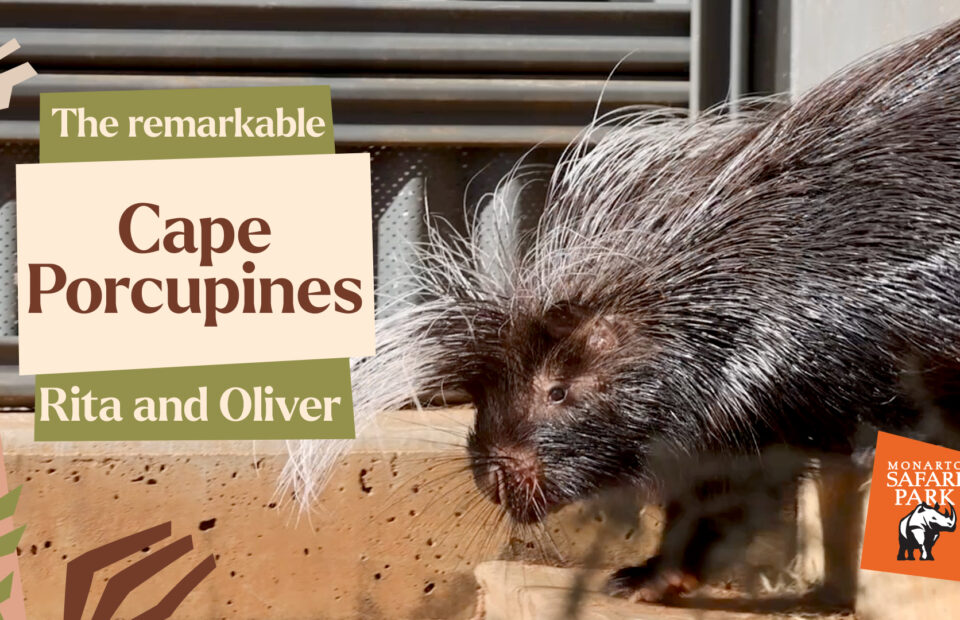
If you grew up watching cartoons, you might think porcupines can shoot their quills.
But here at Monarto Safari Park, Native Species Supervisor Gemma is quick to set the record straight.
“When a predator threatens them, they don’t fire their quills,” she explains. “Instead, they puff themselves up and back into the threat.”
Cape Porcupines have quills that are loosely embedded in their skin. When they reverse into a predator — a Lion or Leopard in the wild — the quills detach and lodge in the attacker’s skin. Each quill is tipped with microscopic barbs, which makes them difficult to remove and an effective deterrent. It’s often enough of a distraction to give the porcupine time to escape.
It’s a defence strategy that’s clever, efficient and entirely their own.

The world’s largest rodent (with a rocker edge)
Rita and Oliver, Monarto’s resident Cape Porcupines, are both 10 years old and have called the park home for nearly nine years.
Cape Porcupines are one of the largest rodents in the world, reaching up to a metre in length and weighing as much as 27 kilograms. Rita tips the scales at 18 kilograms, while Oliver is a little lighter at 16.
They’re easy to tell apart.
Rita is the larger of the two and undeniably the boss. Cape Porcupines are matriarchal, meaning females lead the social structure, and in this partnership, Rita is “large and in charge,” as Gemma puts it. She sports a distinctive, slightly rebellious crest of quills that gives her a rocker-style silhouette.
Oliver’s crest is more slicked back, though thinning a little as he ages and his personality is just as gentle as his appearance suggests.
“Rita is always first to everything,” Gemma says. “First out the gate in the morning, first to enrichment, first to interact with keepers. Oliver is more thoughtful. He lets Rita go first and then decides if he’d like to join in.”
Life after dark
Like many of Australia’s native mammals, Cape Porcupines are nocturnal. While visitors are heading home and the sun dips below the horizon, Rita and Oliver are just getting started.
Overnight camera footage reveals a surprisingly active routine. They patrol their habitat, chew on logs to maintain healthy teeth, dig, climb and forage. In the wild, Cape Porcupines can travel up to 15 kilometres in a single night in search of food and suitable burrowing sites.
As herbivores, their diet consists of roots, shoots and bulbs, tough plant material that matches their robust build.
During the day, they often retreat to their den to rest. With excellent hearing, they’re sensitive to sudden or loud noises, which means patience and a quiet approach gives visitors the best chance of spotting them. Early morning, between 9 and 10am, is typically your best window.
A growing legacy
Rita and Oliver are more than charismatic residents, they’re also important contributors to the regional population.
Over their nine years at Monarto, they’ve welcomed 10 offspring. Today, their family tree extends to nine grandchildren and five great-grandchildren across Australia and New Zealand.
Cape Porcupines can breed once or twice a year, usually having one or two pups, with triplets a rare but possible surprise. Pairs are often monogamous and may live in small family groups of two to five individuals.
For Zoos SA, every successful birth is part of a bigger picture — maintaining genetically healthy populations in human care and fostering understanding of species that many people have never encountered up close.
Come and see them for yourself
Rita’s bold confidence.
Oliver’s quiet consideration.
And a defence mechanism that’s far more fascinating than fiction.
Next time you visit Monarto Safari Park, take a moment to seek out this impressive pair, and if you’re lucky, you might catch Rita leading the way.